

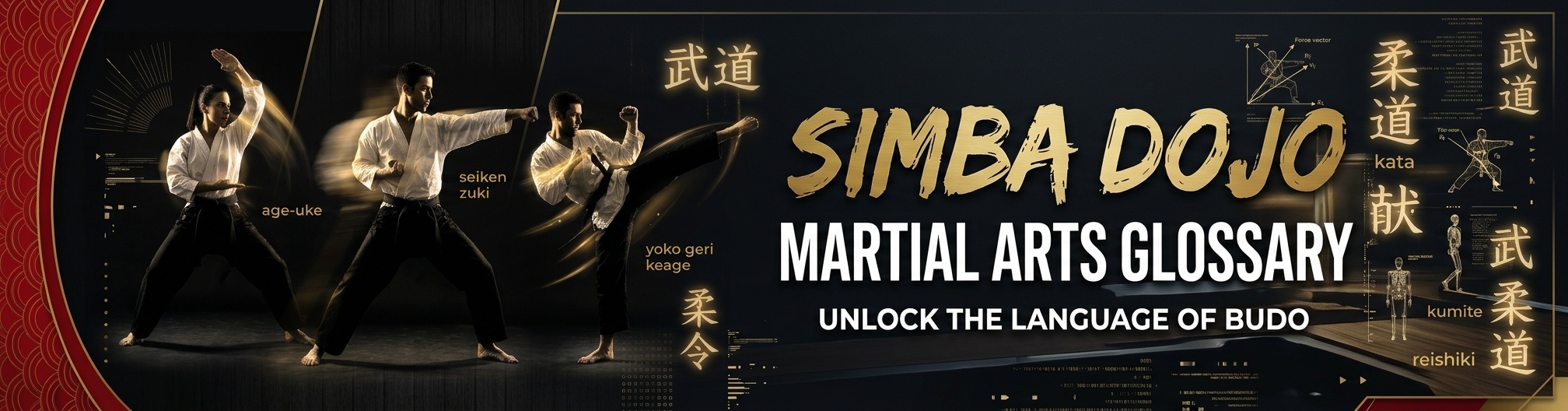
Martial Arts Glossary
Glossary of commonly used terms in the Japanese martial arts.
Glossaries
| Term | Definition |
|---|---|
| Ashi-Hikkake | Ashi-hikkake (足引っ掛け / 足引掛)Ashi-hikkake is a classical foot-trapping and leg-hooking sweeping technique in Shotokan Karate and traditional Japanese Budo, translating directly to "leg hook" or "foot hooking." Executed by hooking the foot or lower leg around an opponent's ankle or calf to disrupt their root and balance (Kuzushi), this close-quarters technique allows a martial artist to trip, destabilize, or unbalance an adversary to facilitate an immediate takedown or follow-up strike.
Author - Sensei Miller
Hits - 33 Synonyms -
Leg hook, foot trapping, ash-hikkake, leg hooking sweep, foot snagging technique. |
| Ashi-Kake | Ashi-kake (足掛け / 足掛)Ashi-kake is a classical foot-hooking, leg-trapping, and tripping technique in Shotokan Karate and traditional Japanese Budo. Executed by placing or hooking the foot or lower leg around an opponent's leg to break their center of gravity (Kuzushi), this close-quarters technique enables a practitioner to unbalance, entangle, or sweep an adversary to execute a immediate takedown or set up a decisive follow-up strike.
Author - Sensei Miller
Hits - 26 Synonyms -
Leg hook, foot trip, leg trapping, ashi kake, leg latching sweep. |
| Ashi-Waza | Ashi-Waza (足技)Ashi-Waza is a major technical classification in Shotokan Karate and traditional Japanese Budo translating to "foot and leg techniques." Encompassing all offensive, defensive, and footwork-based applications performed with the feet and legs, Ashi-Waza includes kicks (Geri-waza), foot sweeps (Ashi-barai), leg hooks (Ashi-kake / Ashi-hikkake), stance shifts (Unsoku / Tai Sabaki), and balance-disrupting takedowns (Kuzushi-waza).
Author - Sensei Miller
Hits - 17 Synonyms -
Foot techniques, leg techniques, footwork and kicking methods, ashi waza, leg sweeps and kicks. |
| Ashibarai | Ashi-barai (足払い)Ashi-barai (frequently written as Ashibarai) is the quintessential foot sweep technique in Shotokan Karate and modern Budo. Executed by sweeping the arch or sole of the foot in a swift, curving arc against an opponent's ankle or lower leg, Ashi-barai is designed to clip or brush away their base of support right as weight is being transferred, disrupting their balance (Kuzushi) and felling them to the tatami or opening them up for an immediate follow-up strike.
Author - Sensei Miller
Hits - 38 Synonyms -
Foot sweep, foot sweeping, leg sweep, ashibarai, de-ashi-barai, sweeping leg technique. |
| Budo | Budo (武道)Budo is the overarching philosophy and cultural framework governing traditional Japanese martial arts, translating directly to "the martial way" or "the way of martial chivalry." Distinct from battlefield techniques focused purely on victory (Bujutsu), Budo represents a lifelong path of ethical discipline, spiritual refinement, and self-mastery. Through the rigorous physical forging (Shugyō) of body and mind, Budo transforms combat systems—such as Shotokan Karate, Judo, Kendo, and Aikido—into vehicles for self-cultivation, moral character, and lifelong personal development.
Author - Sensei Miller
Hits - 29 Synonyms -
The martial way, Japanese martial arts philosophy, martial path, way of Budo, bushido way. |
| Budō-ka | Budō-ka (武道家)Budō-ka is a traditional Japanese term translating directly to "practitioner of the martial way" or "martial artist." It refers to an individual who dedicates themselves to the lifelong study, practice, and embodiment of Budō (武道). Far beyond simply learning physical self-defense tactics or competing for sport, a genuine Budō-ka integrates martial discipline, moral ethics, character development, and spiritual refinement into every facet of daily life.
Author - Sensei Miller
Hits - 45 Synonyms -
Martial artist, practitioner of the martial way, budoka, traditional martial artist, follower of budo. |
| Bugei | Bugei (武芸)Bugei is a traditional Japanese term translating directly to "martial arts," "warrior arts," or "crafts of combat." Historically denoting the broad spectrum of military disciplines, weapons training, and combat tactics practiced by the samurai class, Bugei emphasizes technical mastery, tactical execution, and practical skill. While closely related to Bujutsu (combat techniques) and Budo (the philosophical martial way), Bugei specifically highlights the technical craftsmanship, artistry, and refined skill inherent in martial discipline.
Author - Sensei Miller
Hits - 59 Synonyms -
Martial arts, warrior arts, combat crafts, traditional Japanese martial disciplines, bugei arts. |
| Bujutsu | Bujutsu (武術)Bujutsu is a traditional Japanese term translating directly to "martial techniques," "combative methods," or "science of war." Historically originating on the feuding battlefields of feudal Japan, Bujutsu encompasses the pragmatic, highly functional systems of combat developed strictly for tactical survival, neutralisation of adversaries, and battlefield victory. Unlike modern sport or character-building paths, Bujutsu prioritizes raw combative efficiency, biomechanical leverage, and direct tactical application.
Author - Sensei Miller
Hits - 29 Synonyms -
Martial techniques, combat science, warrior methods, combative arts, traditional Japanese combat skills, bujutsu. |
| Bunkai | Bunkai (分解)Bunkai is a core pedagogical process and practical analysis method in Shotokan Karate and traditional Japanese martial arts, translating directly to "analysis," "disassembly," or "deconstruction." It refers to the systematic extraction, breakdown, and combat application of movements encoded within formal patterns (Kata). Through Bunkai, individual kata techniques—which may appear abstract or purely defensive during solo practice—are decoded into functional self-defense applications, revealing strikes, joint locks, sweeps, throws, and vital point attacks against a live opponent.
Author - Sensei Miller
Hits - 21 Synonyms -
Kata application, practical analysis, kata breakdown, bunkai jutsu, combative interpretation, kata decoding. |
| Dachi | Dachi (立ち / 立)Dachi (often rendered as Tachi when uncompounded) is a fundamental technical term in Shotokan Karate and traditional Japanese Budo translating directly to "stance," "posture," or "standing position." It represents the foundational base of support from which all defensive blocks, offensive strikes, footwork shifts, and balance control (Kuzushi) originate. In traditional Karate, a stance is not a static or rigid position, but a dynamic structural foundation that grounds kinetic energy, lowers the center of gravity (Tanden), and facilitates maximum power transfer (Kime).
Author - Sensei Miller
Hits - 21 Synonyms -
Karate stance, standing posture, tachi, stance mechanics, structural base. |
| Dan | Dan (段)Dan is the formal ranking system and grade designation in Shotokan Karate and traditional Japanese Budo representing advanced levels of proficiency, knowledge, and master-level achievement. Translating directly to "step," "degree," or "grade," the Dan system denotes all ranks at or above black belt (Yūdansha). Contrary to popular belief that earning a first-degree black belt (Shodan) signifies final mastery, the Dan system marks the end of foundational preparation and the true beginning of a martial artist's lifelong journey toward deep technical, philosophical, and personal refinement.
Author - Sensei Miller
Hits - 22 Synonyms -
Black belt rank, dan grade, black belt degree, yudansha rank, karate black belt level. |
| De-Ashi-Barai | De-ashi-barai (出足払い)De-ashi-barai (often written as Deashi-barai) is a classic, precision-based foot sweep in Shotokan Karate and traditional Japanese Budo, translating directly to "advanced foot sweep" or "forward stepping foot sweep." Executed by catching an opponent’s stepping or advancing foot with the sole or arch of one's own foot precisely at the instant it bears weight, De-ashi-barai neutralizes an incoming attack, collapses the opponent's base of support (Kuzushi), and takes them down to the tatami or opens a vital gap for a decisive counter-strike.
Author - Sensei Miller
Hits - 22 Synonyms -
Advancing foot sweep, forward foot sweep, deashi barai, lead leg sweep, timing foot sweep. |
| Do | Dō (道)Dō (frequently rendered as Do or Michi) is a foundational philosophical concept in traditional Japanese martial arts and Eastern philosophy, translating directly to "way," "path," "road," or "lifelong journey." In the context of Japanese Budo and Shotokan Karate (Karate-Dō), Dō signifies the transformation of martial techniques (Jutsu) from mere physical combat and self-defense methods into a profound vehicle for spiritual discipline, moral character, emotional composure, and lifelong self-mastery.
Author - Sensei Miller
Hits - 17 Synonyms -
The way, path, philosophical journey, martial way, tao, michi. |
| Domo Arigato Gozaimasu | Dōmo Arigatō Gozaimasu (有難う御座います / どうも有難う御座います)Dōmo Arigatō Gozaimasu is the formal Japanese expression for "thank you very much." In Shotokan Karate and traditional Japanese Budo, this phrase serves as an essential pillar of dojo etiquette (Reirō), expressing deep gratitude, mutual respect, and humility between students, senior practitioners (Senpai), instructors (Sensei), and training partners. Spoken while bowing (Rei), it acknowledges the gift of instruction, the shared effort of training, and the safe exchange of martial knowledge.
Author - Sensei Miller
Hits - 16 Synonyms -
Thank you very much, formal Japanese thank you, domo arigato gozaimashita, japanese dojo gratitude, polite bow expression. |
| Empi-uchi | Empi-uchi (肘打ち / 猿臂打ち)Empi-uchi (frequently rendered as Empi-uchi or Hijiatami) is the primary class of elbow strike techniques in Shotokan Karate and traditional Japanese Budo. Executed by driving the hard, bony point of the flexed elbow joint or the surrounding forearm bone into an opponent at close range, Empi-uchi delivers devastating kinetic force. Because the elbow leverages the full rotation of the hips (Koshi no Kaiten) and core over a short trajectory, it represents one of the most powerful striking weapons in close-quarters combat (Chika-ma).
Author - Sensei Miller
Hits - 18 Synonyms -
Elbow strike, hiji-ate, enpi-uchi, elbow strikes karate, ape arm strike. |