The Center on Main™ in Verrado®
4239 N Village Street
Buckeye, AZ 85396

Monday and Friday
7:30 pm - 8:30 pm

The Center on Main™ in Verrado®
4239 N Village St
Buckeye, AZ 85396

Monday and Friday
7:30 pm - 8:30 pm

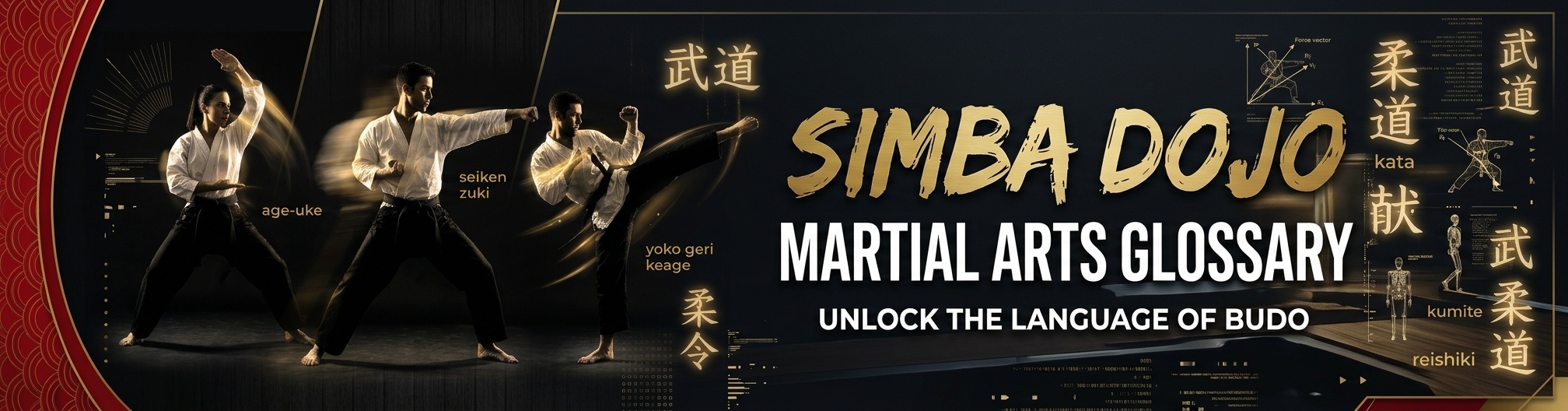
simba dojo glossary banner v2

Jū (柔)

Search for glossary terms (regular expression allowed)

Glossaries

Term Definition
Jū (柔)

Jū (柔)

In Japanese martial arts, Jū (柔) represents the principle of softness, flexibility, yielding, adaptability, and gentleness. In combat philosophy and Shotokan Karate, it refers to the tactical concept of blending with, redirecting, or absorbing incoming force rather than meeting an opponent’s power with direct, rigid opposition (Go).

Etymology & Structural Breakdown

The kanji 柔 means "soft," "tender," "flexible," or "yielding."

  • Radical Components: The character consists of elements signifying "spear" or "flexible wood" (矛) over "tree/wood" (木), originally representing supple wood or bamboo that can bend under pressure without snapping.

  • Linguistic Context: It is the foundational character found in arts like Jujutsu (柔術, soft art) and Judo (柔道, soft way), as well as the martial concept Go-Ju (剛柔, hard-soft dynamic).

Key Characteristics & Components

  • Yielding & Redirection: Avoiding direct head-on collision with force; stepping or pivoting off the line of attack to divert an opponent's energy.

  • Suppleness & Fluidity: Maintaining physical relaxation and joint flexibility until the moment of execution or redirection.

  • Energy Efficiency: Utilizing minimal effort to achieve maximum outcome (Seiryoku Zenyo) by leveraging an opponent's weight, momentum, and overcommitment.

  • Harmonious Balance: Complementing Go (hardness/rigidity) to form a complete, adaptable combat system.

Practical and Tactical Application in Shotokan Karate

Although Shotokan Karate is often recognized for its direct linear power (Go), the principle of Jū is critical to high-level mastery and application (bunkai):

  • Defensive Deflection (Nagashi-uke & Kake-uke): Using sweeping, circular, or hooking open-hand blocks to guide incoming strikes past the body rather than attempting to smash them.

  • Evasion & Body Evasion (Tai-sabaki): Shifting weight and turning hips smoothly to let an attack miss by millimeters while maintaining balance.

  • Grappling & Joint Manipulation (Tuite / Kansetsu-waza): Applying joint locks, unbalancing mechanics (Kuzushi), and takedowns found in advanced kata (e.g., Bassai Dai, Kanku Dai, Nijushiho) by yielding to opponent movement.

Key Variations & Mechanics

  • Ju-no-ri (Principle of Flexibility): Responding fluidly to an opponent's changing tactics without physical or mental rigidity.

  • Ju-no-Sen (Initiative of Softness): Waiting for the opponent to initiate, yielding to their entry, and exploiting their resulting instability or open guard.

  • Relaxation to Tension Timing: Keeping muscles relaxed during movement to maximize speed and adaptability, contracting (kime) only at the instant of final application or lock.

Budo & Cultural Significance

In Budo culture and Asian philosophy (heavily influenced by Taoist thought), Jū embodies the idea that "the soft and supple will overcome the hard and strong," just as a flexible willow tree survives a heavy snowfall while rigid branches break. It teaches karateka humility, emotional control, and the wisdom of non-resistance—proving that supreme victory comes from adaptability and harmony rather than brute force alone.

Author - Sensei Miller
Hits - 30
Synonyms: Softness, flexibility, yielding, gentleness, adaptability, suppleness, non-resistance
Ask a question
1000 characters left