The Center on Main™ in Verrado®
4239 N Village Street
Buckeye, AZ 85396

Monday and Friday
7:30 pm - 8:30 pm

The Center on Main™ in Verrado®
4239 N Village St
Buckeye, AZ 85396

Monday and Friday
7:30 pm - 8:30 pm

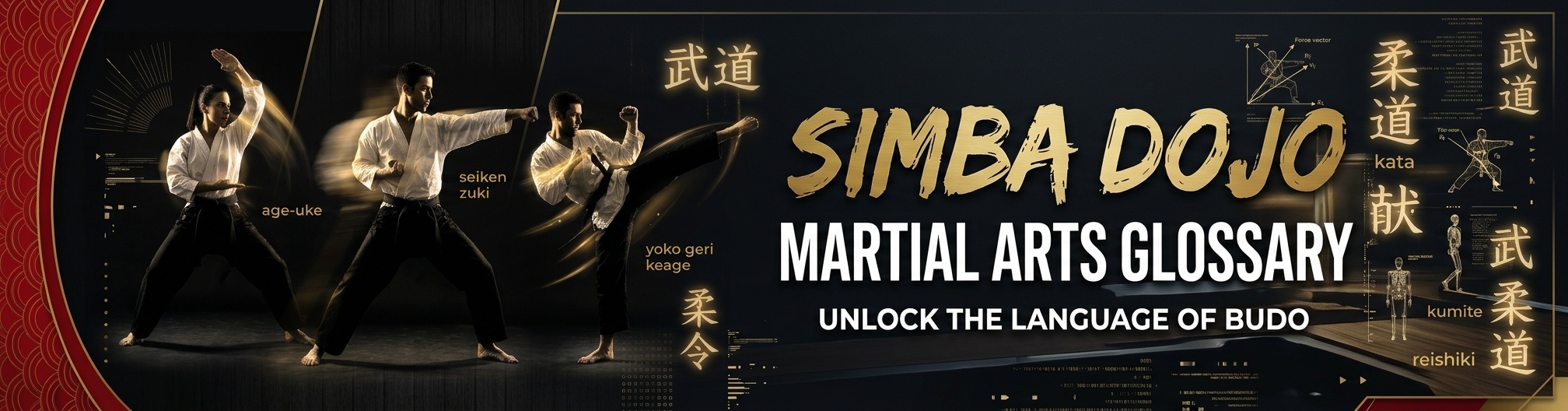
simba dojo glossary banner v2

Kamaete

Search for glossary terms (regular expression allowed)

Glossaries

Term Definition
Kamaete

Kamaete (構えて)

Kamaete (構えて) is the formal Japanese verbal command used in traditional martial arts meaning "take your stance," "assume your guard," or "get ready." In Shotokan Karate, it is called out by an instructor (Sensei) or referee (Shupan) to direct practitioners to instantly snap into a designated combative ready posture (kamae) with physical stability and mental alertness (zanshin).

Etymology & Structural Breakdown

The term is the imperative / conjunctive te-form of the Japanese verb kamaeru (構える):

  • Kamaeru (構える): Verb root meaning "to construct," "to establish," "to set up," or "to adopt a stance."

  • Kanji (構): Composed of radicals for "wood/structure" (木) and "construction" (构), denoting a solid framework or protective setup.

  • Te-form (構えて): Functions as a direct instruction or command in spoken Japanese, ordering karateka to immediately assume their designated posture or guard.

Key Characteristics & Components

  • Auditory Trigger: Serves as the precise command directing karateka to transition from a passive state into an active fighting stance.

  • Instantaneous Snap: Demands rapid lowering of the center of gravity and sudden positioning of the limbs without hesitation or telegraphing.

  • Vocal Integration with Kiai: Commonly accompanied by a sharp, energetic vocalization (kiai) from practitioners as they take their stance.

  • Structural Protection: Instantly establishes defensive coverage over the body’s centerline while unlocking the hips and knees for fluid movement.

Practical and Tactical Application in Shotokan Karate

In Shotokan Karate training, line drills, and tournament competition, Kamaete is utilized across multiple training modalities:

  • Kihon and Line Drills: Instructors issue the command (e.g., "Zenkutsu-dachi gedan-barai, kamaete!") to order students into their starting stance before beginning linear combinations.

  • Sparring (Kumite): Referees call out the command before commencing a match or drill, prompting both competitors to establish their free-sparring guard (jiyu-kamae).

  • Kata Partner Application (Bunkai): Used to direct the attacker (tori) and defender (uke) to take their respective starting guards before demonstrating a drill.

Key Variations & Mechanics

  • Gedan-Barai Kamaete: Instructs practitioners to step into a front stance (zenkutsu-dachi) while sweeping a low downward block.

  • Jiyu-Kamaete: Orders karateka to assume a flexible, mobile free-sparring guard.

  • Biomechanical Mechanics: Execution requires pushing dynamically off the floor using ground reaction force, settling weight into the lower abdomen (tanden), and relaxing the shoulders to preserve explosive speed.

Budo & Cultural Significance

In Budo culture, responding to the command Kamaete tests a practitioner's immediate mental presence. Taking a guard is not merely a physical movement, but the instant activation of Zanshin (unbroken awareness) and spirit. A sharp, committed response to Kamaete demonstrates respect for the instructor, readiness for combat, and absolute mastery over body and mind.

Author - Sensei Miller
Hits - 14
Synonyms: Take your guard, assume posture, get ready command, stance command, posture command, fighting guard command
Ask a question
1000 characters left