General
General Category


General Category
Few figures in modern martial arts history have left as profound and enduring a mark as Gichin Funakoshi (船越 義珍, 1868–1957). Widely revered as the "Father of Modern Karate," Master Funakoshi transformed an island combat art into a worldwide discipline of character, respect, and physical mastery. Through his dedication, technical refinement, and philosophical insight, he reshaped Karate from a secret Okinawan tradition into Karate-Do—the "Way of the Empty Hand."
Born in Shuri, Okinawa, in 1868—the year of the Meiji Restoration—Funakoshi was a sickly child who initially began training in martial arts to improve his health. Under the guidance of two of Okinawa’s most respected masters, Ankō Asato and Ankō Itosu, he immersed himself in the classical traditions of Shorei-ryu and Shorin-ryu.
During this era, training was conducted in secrecy, often at night in secluded locations. Through rigorous practice, Funakoshi developed deep technical proficiency and an abiding appreciation for the inner discipline required by martial arts. As he grew into adulthood, he became a schoolteacher, bringing a natural educator's clarity and patience to his lifelong study of the arts.
In 1922, Funakoshi was selected to represent Okinawa at the First National Athletic Exhibition in Tokyo, organized by the Japanese Ministry of Education. His demonstration of Okinawan karate captivated the Japanese public and elite martial artists alike, including Jigoro Kano, the founder of Judo.
Recognizing the immense value of what Funakoshi had to offer, leaders in mainland Japan urged him to stay. Funakoshi made the life-changing decision to remain in Tokyo, dedicating the rest of his life to introducing, refining, and codifying karate for future generations.
One of Funakoshi’s most important contributions was the philosophical and linguistic transformation of the art:
Changing the Kanji: Historically, karate was written as 唐手 ("Chinese Hand"). Funakoshi introduced the character 空 ("Empty"), reshaping the name to 空手 (Karate, or "Empty Hand").
Emphasizing Do (The Way): By adding Do (道), he aligned karate with modern Budo traditions (like Judo and Kendo). This shifted the emphasis away from pure fighting techniques toward holistic self-improvement, mental fortitude, and spiritual growth.
When his students constructed a dedicated dojo in Tokyo in 1939, they placed a sign over the entrance reading Shotokan (松濤館)—combining Funakoshi’s pen name, Shoto ("Pine Waves," referring to the rustling of pine needles in the wind near his home in Shuri), with Kan ("Hall" or "Dojo").
Master Funakoshi firmly believed that physical technique meant nothing without moral rectitude. He famously stated:
"The ultimate aim of Karate lies not in victory or defeat, but in the perfection of the character of its participants."
To guide practitioners both inside and outside the dojo, he codified The Twenty Precepts of Karate (Niju Kun). These fundamental principles continue to form the ethical foundation of Shotokan Karate today. Among the most famous are:
Karate-do begins and ends with respect (Karate-do wa rei ni hajimari, rei ni owaru koto).
There is no first strike in Karate (Karate ni sente nashi).
Karate is an aid to justice (Karate wa gi no tasuke).
First control yourself, then control others (Mazu jiki wo shiro, nochi ni shi wo shiro).
Funakoshi systematically organized karate’s stances, blocks, strikes, and kata to make group instruction safe, structured, and accessible. He emphasized strong foundational stances (kibatachi, zenkutsu-dachi, fudo-dachi), precise line of movement, and the study of traditional kata (such as the Heian series, Tekki, Empi, and Kanku-dai).
He also authored several influential texts, including Karate-Do Kyohan (the master textbook) and his autobiography, Karate-Do: My Way of Life, which remain essential reading for practitioners around the globe.
Gichin Funakoshi passed away in April 1957 at the age of 88, leaving behind a global legacy. Today, tens of millions of people practice Shotokan Karate across every continent.
Master Funakoshi’s life serves as a reminder that true martial arts mastery goes far beyond physical prowess—it is found in humility, lifelong learning, and the continuous refinement of one's spirit.
A haiku is a traditional form of Japanese poetry renowned for its brevity, simplicity, and deep focus on the natural world. Originating as the opening verse (hokku) of longer collaborative poems called renga, haiku evolved into an independent literary art form popularized by legendary poets like Matsuo Bashō in the 17th century. Rather than telling a story or expressing complex personal arguments, a haiku captures a brief, vivid moment in time—often contrasting two distinct images to evoke a specific emotional resonance or sudden insight.
Writing a traditional haiku follows a few structural and thematic rules:
Pines wave in the breeze,
Karate my endeavor,
Simba my spirit!
-Sensei Miller-2019
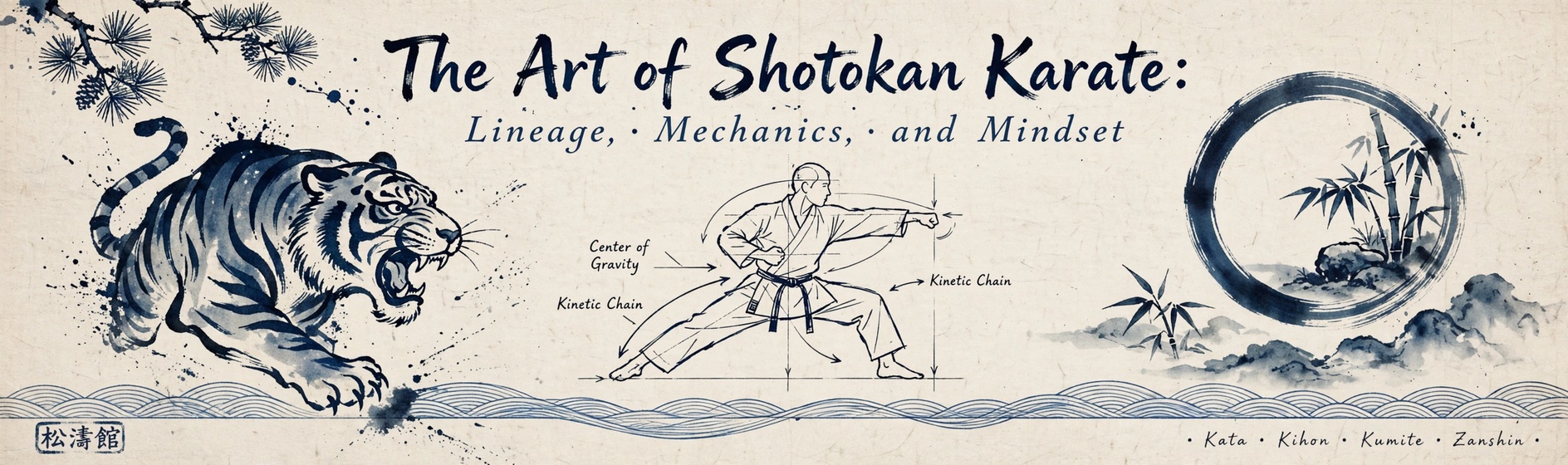
Shotokan Karate (松濤館) stands as one of the most widely practiced and respected traditional martial arts in the world. Characterized by its dynamic linear movements, deep stances, and uncompromising commitment to mental discipline, Shotokan is far more than a system of self-defense—it is a lifelong path of personal growth, character development, and physical mastery (Budo).
The roots of Shotokan trace back to the island of Okinawa, where indigenous fighting techniques (Te) merged with Chinese martial arts influences. In the early 20th century, Master Gichin Funakoshi (1868–1957)—a schoolteacher from Okinawa—brought this art to mainland Japan.
Funakoshi believed that karate should serve to build character, physical health, and mutual respect. In 1939, his students established the first official head dojo in Tokyo, naming it the Shotokan (Shōtō, meaning "Pine Waves," was Funakoshi’s poetic pen name, and Kan means "Hall").
Together with his son, Yoshitaka Funakoshi, who introduced lower stances, long-range kicks, and explosive dynamics, Master Funakoshi modernized the system into the structured Japanese discipline recognized today.
Shotokan training relies on three interconnected pillars, each building upon the other to forge a balanced martial artist:
Kihon is the repetitive practice of isolated stances, punches, blocks, strikes, and kicks. Through line drills, practitioners refine body alignment, breath control, hip engagement (koshino kaiten), and the rapid transition from relaxation to tension at impact (kime).
Kata consists of choreographed sequences of defensive and offensive movements against imaginary opponents. Shotokan preserves over 25 core kata—ranging from fundamental patterns like the Heian series to advanced kata like Kanku-Dai, Jion, and Hangetsu. Kata practice instills muscle memory, rhythm, balance, and tactical awareness (bunkai).
Kumite translates formal technique into dynamic application. Shotokan employs a structured progression:
Gohon & Sanbon Kumite: Five-step and three-step basic sparring for distance and timing.
Ippon Kumite: One-step sparring focusing on single, decisive defenses and counter-strikes.
Jiyu Ippon Kumite: Semi-free sparring with continuous movement and announced attacks.
Jiyu Kumite: Unscripted free sparring emphasizing control (sundome), strategy, and real-time adaptability.
What sets Shotokan apart technically is its emphasis on strong foundation and full-body kinetic energy:
Deep, Grounded Stances: Stances like Zenkutsu-dachi (forward stance), Kokutsu-dachi (back stance), and Kiba-dachi (horse-riding stance) lower the center of gravity, forging leg strength and maximum stability.
Hip Dynamics: Power does not come from the arms alone, but from the explosive rotation and snap of the hips.
Hikite (Pulling Hand): As one hand strikes or blocks, the opposite hand chambered sharply at the hip creates a counter-balancing reactionary force.
Ikken Hissatsu (To Defeat with One Blow): The principle that every technique should be executed with maximum focus, efficiency, and intent.
At its core, Shotokan is a philosophical discipline guided by the Dojo Kun (dojo rules) and the Niju Kun (Twenty Precepts of Karate) articulated by Master Funakoshi.
The central tenet of Shotokan philosophy is encapsulated in the famous phrase:
"Karate ni sente nashi" — There is no first strike in karate.
This principle reminds martial artists that karate is fundamentally defensive, intended to resolve conflict and preserve peace rather than incite violence. Through rigorous physical training, the practitioner learns patience, humility, self-control, and respect (Rei) for others—both inside and outside the dojo.
In a modern culture dominated by online cynicism, talk-over dialogues, and self-centered ambition, genuine respect often feels like a fading art. We hear demands for respect everywhere, yet we rarely see a structured practice dedicated to cultivating it.
Step onto the tatami mats at Simba Dojo, however, and the atmosphere changes instantly.
Before a single technique is practiced, before a foot lands on the floor, the space falls quiet. Every practitioner, regardless of rank, age, or background, lowers their eyes and bows. In that single, deliberate gesture lies the core secret of traditional Karate: respect is not just an abstract virtue—it is a physical, daily habit.
While Karate is renowned for its martial power and striking precision, its true strength lies in how it systematically instills respect for oneself, for others, and for the journey of life. Here is how training at Simba Dojo fosters profound, lifelong respect.
In traditional Japanese martial arts, the dojo is far more than a gym; it is a sanctuary for personal growth. The practice of Reiho (dojo etiquette and formal bowing) begins the moment you cross the threshold.
When a student bows upon entering Simba Dojo, they perform a conscious mental reset. They leave their external status, daily worries, and ego at the door. By honoring the space where hard work occurs, karateka learn environmental respect. They begin to treat their surroundings—whether a classroom, workplace, or home—with mindfulness and care.
In a world that often challenges authority for the sake of friction, Karate teaches structured, earned reverence.
Sensei (Teacher): Translates literally to "one who has walked the path before." Students bow to the Sensei not out of fear, but out of gratitude for their guidance, wisdom, and dedicated mentorship.
Senpai (Senior Students): Junior students (Kohai) learn to respect their seniors, recognizing the years of sweat and effort required to attain higher rank.
This dynamic teaches practitioners to honor experience and seek wisdom. It fosters humility, encouraging students to listen deeply and absorb lessons with a clean slate (shoshin or "beginner’s mind").
You cannot master Karate alone. Progress depends entirely on having training partners who are willing to throw strikes at you and trust you to strike back safely.
During Kihon-kumite (partner drills) and free sparring, respect is a matter of physical safety. A karateka must deliver techniques with maximum speed and energy (kime), yet hold absolute spatial control (sun-dome) to stop millimeters from their partner's body.
This creates a profound bond of mutual trust. You learn to view your training partner not as an adversary to crush, but as a valued teammate helping you sharpen your skills. Every sparring session at Simba Dojo begins with a bow (Rei) and ends with a bow, reinforcing that combat without respect is merely violence.
Whether in tournament competition or casual dojo sparring, Karate strips away excuses. When a strike connects or a technique fails, there is no referee to blame and no teammate to hide behind.
Karate teaches students to accept victory with quiet humility and defeat with dignifying grace. Winning without boasting demonstrates respect for your opponent's effort; losing without making excuses demonstrates respect for the truth of the moment. This builds emotional maturity, preparing students to navigate life's inevitable setbacks with composure.
Perhaps the most transformative form of respect Karate instills is self-respect.
Self-respect is not born from unearned praise; it is earned through facing friction, pushing through physical fatigue, and overcoming self-doubt. When a student struggles through a grueling stance session, masters a complex Kata, or pushes past their perceived limits during basic drills, they realize what they are truly capable of.
A person who respects themselves takes care of their physical body, guards their mental focus, stands up for their values, and treats others with natural dignity. As Master Gichin Funakoshi famously stated in his Niju Kun:
"Karate-dō wa rei ni hajimari, rei ni owaru."
(Karate-dō begins and ends with respect.)
At Simba Dojo, we believe that punching and kicking are simply the vehicles; character is the destination.
When you or your child step onto our mats, you are not just learning how to defend yourself—you are joining a community dedicated to raising respectful leaders, compassionate training partners, and resilient individuals. The bows we exchange inside the dojo become the foundation for how we treat the world outside its walls.
Mastering the Japanese numerical system is one of the most practical and satisfying milestones for language learners and martial arts practitioners alike. Whether you are keeping count during dojo line drills (Kihon), counting currency, or telling time, understanding how Japanese numbers connect logically will allow you to count to 99,999 with surprising speed.
Unlike many Western numerical systems, Japanese numbers follow an exceptionally consistent, base-10 mathematical structure with virtually no irregular rules once you learn the core foundational numbers.
The core of the entire system begins with numbers 1 through 10. In Japanese, there are two primary systems for counting: the Sino-Japanese system (derived from Chinese, used for general counting, math, and technical commands) and the Native Japanese system (used primarily for counting physical objects up to 10).
Below is the standard Sino-Japanese system used in everyday life and martial arts:
| Number | Kanji | Romaji | Pronunciation Guide |
| 1 | 一 | Ichi | ee-chee |
| 2 | 二 | Ni | nee |
| 3 | 三 | San | sahn |
| 4 | 四 | Shi / Yon | shee / yohn |
| 5 | 五 | Go | goh |
| 6 | 六 | Roku | roh-koo |
| 7 | 七 | Shichi / Nana | shee-chee / nah-nah |
| 8 | 八 | Hachi | hah-chee |
| 9 | 九 | Kyū / Ku | kyoo / koo |
| 10 | 十 | Jū | joo |
Cultural Note on 4 and 7:
The number 4 (Shi) is phonetically identical to the Japanese word for death (死, shi). Because of this superstition (imikotoba), Yon is frequently substituted for 4 in everyday conversation. Similarly, 7 is often pronounced Nana to avoid confusion with 1 (Ichi) or 4 (Shi).
Building numbers from 11 to 99 follows simple additive and multiplicative logic. You do not need to memorize new words for "twelve," "twenty," or "fifty."
                 BUILDING JAPANESE NUMBERS (11 - 99)

  [ Addition: 11 to 19 ]          [ Multiplication: Tens Units (20, 30, 40...) ]
  10 (Jū) + Single Digit           Single Digit + 10 (Jū)

  • 11 = Jū-ichi  (10 + 1)         • 20 = Ni-jū   (2 × 10)
  • 12 = Jū-ni    (10 + 2)         • 30 = San-jū  (3 × 10)
  • 15 = Jū-go    (10 + 5)         • 50 = Go-jū   (5 × 10)
Combine Jū (10) with the single-digit number:
11: Jū-ichi (10 + 1)
12: Jū-ni (10 + 2)
13: Jū-san (10 + 3)
14: Jū-yon / Jū-shi (10 + 4)
18: Jū-hachi (10 + 8)
Place the multiplier before Jū (10):
20: Ni-jū (2 × 10)
30: San-jū (3 × 10)
40: Yon-jū (4 × 10)
90: Kyū-jū (9 × 10)
Simply stack the multiplier, the ten unit, and the remaining digit:
25: Ni-jū-go (2 × 10 + 5)
47: Yon-jū-nana (4 × 10 + 7)
99: Kyū-jū-kyū (9 × 10 + 9)
When stepping into larger numbers, Japanese introduces specific base markers for 100, 1,000, and 10,000.
| Value | Kanji | Romaji | Notes & Sound Changes (Rendaku) |
| 100 | 百 | Hyaku | 300 (San-byaku), 600 (Roppyaku), 800 (Happyaku) |
| 1,000 | 千 | Sen | 3,000 (San-zen), 8,000 (Hassen) |
| 10,000 | 万 | Man | Japanese counts large numbers in units of 10,000 (Myriads) |
                       THE 10,000 (MAN) SYSTEM SHIFT

  English System (Groups of 1,000):
  10,000  = "Ten Thousand"  (10 × 1,000)

  Japanese System (Groups of 10,000):
  10,000  = Ichiman (1 × 10,000)
  50,000  = Goman   (5 × 10,000)
Unlike Western languages that group large numbers by thousands (1,000 = thousand, 1,000,000 = million), Japanese shifts to units of 10,000 (万, Man). For example:
10,000: Ichi-man (1 unit of 10,000)
20,000: Ni-man (2 units of 10,000)
100,000: Jū-man (10 units of 10,000)
For counting physical items (such as apples, chairs, or general objects) up to 10 without using specific counter words, Japanese uses the native Wago counting system:
In traditional Budo dojos (such as Shotokan Karate or Judo), counts are used during warm-ups, line drills (Kihon), and repetitive form practice.
Here is how counts are typically called out on the mat:
  Call:   1   -   2   -   3   -   4   -   5   -   6   -   7   -   8   -   9   -  10
  Audio: Ichi -  Ni   -  San  -  Shi  -  Go   - Roku  - Shichi- Hachi -  Kyū  -  Jū
When pacing rhythm during drills, instructors often count 1 through 8 or 1 through 10 in rapid succession, emphasizing crisp execution on every single count.
Master 1 through 10 first: (Ichi, Ni, San, Shi/Yon, Go, Roku, Shichi/Nana, Hachi, Kyū, Jū).
Use logic for 11–99: Ten-plus-unit for teens (Jū-ni); Unit-plus-ten for multiples of ten (Ni-jū).
Remember 4 and 7: Use Yon (4) and Nana (7) for general clarity in speech.
Practice rhythm: Recite numbers aloud to naturalize the cadence and breath control.
Today, Karate is recognized globally as one of the most practiced martial arts in the world, renowned for its dynamic striking, crisp forms (Kata), and deep philosophical roots. Yet the art known today as "Karate-do" (the Way of the Empty Hand) is not a single, unchanging system. Instead, it is a living art shaped by centuries of cultural exchange, secret practice, historical adaptation, and modern evolution.
The story of Karate begins on the island of Okinawa, the principal island of the Ryukyu Kingdom. Situated at a crucial trade crossroads between Japan, China, and Southeast Asia, Okinawa absorbed diverse cultural influences for centuries.
Originally, the native Okinawan fighting system was known simply as Te (手, meaning "Hand"). In the 14th century, formal diplomatic ties with China introduced Okinawan practitioners to Southern Chinese kung fu (Quanfa or Kempo). Over generations, indigenous grappling and striking merged with Chinese striking principles, giving rise to Tōde (唐手, "Chinese Hand").
Following weapon bans enacted by the Ryukyu monarchy and later enforced by the Japanese Satsuma Clan in the 17th century, empty-hand combat developed rapidly in secrecy.
By the late 19th century, training clustered around three primary Okinawan towns, yielding distinct stylistic characteristics:
Shuri-te (首里手): Developed around the royal capital of Shuri. Characterized by quick, linear movements, fast footwork, and lighter, natural stances designed for rapid entry and exit.
Naha-te (那覇手): Developed in the commercial port town of Naha. heavily influenced by Southern Chinese Crane styles, emphasizing heavy, rooted stances (Sanchin dachi), power generation through tension and breath control (Ibuki), and close-quarters grappling.
Tomari-te (泊手): Developed in the coastal town of Tomari. A hybrid blending the quick agility of Shuri-te with the close-range power of Naha-te.
In the early 20th century, masters like Anko Itosu introduced Karate into the Okinawan public school system, refining techniques for physical education and safety.
In the 1920s, Okinawan masters traveled to mainland Japan to demonstrate their art. To facilitate adoption within Japan’s established Budo community, the kanji for Karate was officially changed from 唐手 ("Chinese Hand") to 空手 ("Empty Hand"), emphasizing both empty-handed self-defense and the Zen concept of an empty, selfless mind.
This era gave rise to the major traditional styles recognized today:
| Style | Founder | Key Characteristics & Philosophy |
| Shotokan (松濤館) | Gichin Funakoshi | Long, deep stances, explosive linear power, long-range striking, and rigorous physical discipline. |
| Goju-Ryu (剛柔流) | Chojun Miyagi | "Hard-Soft Style." Blends heavy, linear striking (Go) with circular, redirection techniques (Ju) and breath work. |
| Shito-Ryu (糸東流) | Kenwa Mabuni | Combines Shuri-te and Naha-te lineages; renowned for retaining an extensive library of classical Kata. |
| Wado-Ryu (和道流) | Hironori Otsuka | Blends traditional Karate striking with Jujutsu joint locks, sweeps (Ashibarai), body evasion (Tai Sabaki), and leverage. |
As Karate spread globally following World War II, new training philosophies emerged, leading to further stylistic diversification:
Kyokushin (極真): Founded by Masutatsu Oyama in 1957, emphasizing full-contact bare-knuckle sparring (Kumite), extreme physical conditioning, and functional endurance.
Sport Karate (WKF): Focused on high-speed point sparring, precise timing, distance management (Maai), and standardized competition Kata.
The evolution of Karate illustrates how a martial art can maintain its core principles while adapting to new eras and cultures. Whether practiced as classical Okinawan self-defense, traditional Japanese Budo, high-intensity full-contact conditioning, or modern competitive sport, Karate remains a powerful journey of self-discovery, physical mastery, and character development.
In popular culture, earning a black belt is often viewed as the final destination in martial arts training—the ultimate symbol of combat mastery. In traditional Karate-do, however, achieving the black belt is merely the end of preparation and the true beginning of study. This advanced ranking system is known as the Dan (段) system.
The Dan system marks a practitioner’s transition from learning the fundamental mechanics of the art to internalizing its deeper technical, tactical, and philosophical principles.
The word Dan (段) translates literally to step, grade, level, or platform.
Historically, Japanese martial arts utilized the Menkyo (免許) system—a series of licenses or certificates awarded to practitioners based on secret teachings and mastery of specific curricula (such as Shodan, Chūden, and Okuden).
The modern Dan/Kyū system was created by Jigoro Kano (the founder of Judo) in the late 19th century, adapting ranking concepts from board games like Go and Shogi. Gichin Funakoshi, the founder of Shotokan Karate, formally adopted this system for Karate in the 1920s to provide a clear, standardized structure for student evaluation and progression.
Karate practitioners are broadly divided into two structural categories based on rank:
Mudansha (無段者): "Persons without Dan." These are color belt practitioners holding Kyū (級) grades (typically ranging from 10th Kyū beginner to 1st Kyū brown belt). Mudansha focus on building physical strength, learning foundational stances (Dachi), mastering basic strikes and blocks (Kihon), and memorizing elementary forms (Kata).
Yudansha (有段者): "Persons with Dan." These are black belt holders who have mastered basic physical mechanics and have entered the formal Dan system.
While exact belt titles and requirements vary among styles (such as Shotokan, Goju-Ryu, Wado-Ryu, and Shito-Ryu), standard Karate organizations typically recognize ten degrees of Dan:
| Rank | Japanese Term | Meaning | Focus & Character |
| 1st Dan | Shodan (初段) | Beginning Degree | Solid mastery of fundamentals; readiness to begin true study. |
| 2nd Dan | Nidan (二段) | Second Degree | Fluid execution, speed, precision, and integration of technique. |
| 3rd Dan | Sandan (三段) | Third Degree | Deep understanding of Bunkai (application) and tactical timing. |
| 4th Dan | Yondan (四段) | Fourth Degree | Senior technical level; refinement of personal style and instruction. |
| 5th Dan | Godan (五段) | Fifth Degree | Advanced mastery; holistic understanding of body mechanics and Budo. |
| 6th Dan | Rokudan (六段) | Sixth Degree | Senior instructor status (Renshi); contributions to the art. |
| 7th Dan | Shichidan (七段) | Seventh Degree | Expert level (Kyoshi); high-level leadership and wisdom. |
| 8th Dan | Hachidan (八段) | Eighth Degree | Master level (Hanshi); lifelong dedication and pedagogical impact. |
| 9th Dan | Kūdan (九段) | Ninth Degree | Grandmaster level; profound philosophical and historical authority. |
| 10th Dan | Jūdan (十段) | Tenth Degree | Reserved for organizational heads, pioneers, or lifelong masters. |
Note on Shodan: The prefix Sho (初) in Shodan does not mean "number one"; it translates to "beginning" or "first step." Earning a Shodan rank indicates that the student has acquired the baseline tools necessary to begin studying Karate as a true martial way (Budo).
Advancing through the Dan grades requires far more than physical endurance or memorizing additional Kata. As a Yudansha moves higher in rank, testing criteria shift from external execution to internal mastery:
Refinement of Kihon, Kata, and Kumite: Flawless posture, balance, contraction/relaxation timing, and kinetic transfer.
Deep Comprehension of Bunkai: The ability to explain, demonstrate, and adapt complex combative applications (Ōyō) hidden within forms.
Time in Grade (Kankaku): Mandatory years of active practice between ranks to ensure technical maturity and character growth.
Contributions & Character: Moral integrity, humility, leadership within the dojo, teaching contributions, and academic/philosophical thesis work (often required for 4th Dan and above).
The Dan system reinforces one of the core tenets of Karate-do: Karate is a lifelong discipline. A black belt is not a trophy to be earned and set aside, but a commitment to perpetual self-refinement. By viewing each Dan rank as another step on an endless path, the practitioner embodies the true spirit of Budo—striving for physical, mental, and spiritual self-mastery throughout a lifetime.
Self-confidence is often misunderstood. In a world dominated by social media highlights, loud self-promotion, and superficial praise, it is easy to confuse confidence with arrogance. True self-confidence, however, does not come from pretending to have all the answers or putting on a tough front. It comes from knowing—deep down in your core—what you are truly capable of handling when challenged.
At Simba Dojo, we see students walk through our doors every day seeking that exact transformation. Some arrive shy and soft-spoken, while others carry self-doubt or anxiety about their physical abilities.
Yet, month after month, as they step onto the mats, tie their belts, and embrace the traditional practice of Shotokan Karate, a quiet shift occurs. Shoulders push back, eyes lift up, and hesitation turns into decisive action.
How does throwing a punch, learning a kata, or standing in a low stance build such authentic, lasting self-confidence? Here is how training at Simba Dojo unlocks the inner strength of every student.
Real confidence cannot be given; it must be earned. Passive praise might feel good temporarily, but true self-worth develops when you set a hard goal, struggle through the effort, and finally achieve it through your own hard work.
In Karate, progress is transparent and merit-based. A student does not receive their next rank simply by showing up for a set number of weeks. They earn it by mastering fundamental techniques (Kihon), memorizing intricate formal routines (Kata), and demonstrating control in partner training (Kumite).
When a practitioner works through weeks of friction to master a challenging stance like Kiba-dachi or execute a clean front kick (Mae-geri), they gain tangible proof of their own competence. This cycle of effort, mastery, and earned advancement proves to the brain: I can overcome difficult challenges when I apply myself.
Confidence begins with physical posture and presence. Karate systematically retrains how you hold yourself, move through space, and project your energy.
Posture & Rooting: Deep stances teach students to root themselves firmly into the floor, strengthening core muscles and establishing balanced, upright posture. Walking with a straight spine and open chest immediately signals confidence to both yourself and others.
The Power of the Kiai: In modern life, many people—especially children—are rarely encouraged to use their full vocal power. Executing a crisp, diaphragm-driven Kiai (martial shout) forces practitioners to shed self-consciousness, breathe deeply, and express their energy without hesitation.
Eye Contact & Awareness: Karate demands continuous focus (Zanshin). Students learn to keep their chin up, maintain clear eye contact with partners, and move with intentional grace rather than timid uncertainty.
One of the greatest enemies of self-confidence is the fear of making mistakes or looking foolish. Modern culture often punishes failure, leading people to play it safe and stay inside their comfort zones.
At Simba Dojo, the mat is a safe laboratory for trial, error, and growth. You will lose your balance while practicing a new kick; you will forget a step in a kata; you will miss a block during sparring. But inside our dojo, making mistakes is not condemned—it is welcomed as an essential step toward mastery.
By repeatedly experiencing small failures, picking themselves up, making adjustments, and trying again, students lose their fear of falling short. They develop grit. When you no longer fear making mistakes, self-doubt loses its grip, freeing you to try new things and take healthy risks in everyday life.
It is easy to feel confident when everything is running smoothly. The ultimate test of self-confidence is maintaining your composure when unexpected pressure, conflict, or stress arises.
During controlled partner training (Kihon-kumite and sparring), students learn to navigate real-time physical pressure. Adrenaline spikes, timing becomes unpredictable, and an incoming strike requires an immediate, calm response.
Through regular practice, karateka cultivate Fudoshin—the "immovable mind." They discover that they can stay calm under pressure, breathe through discomfort, and trust their training. Knowing that you can handle physical and emotional pressure inside the dojo gives you an unshakeable poise when facing tough tests, public speaking, or tense conversations outside the dojo.
There is a profound difference between the loud bravado of someone trying to prove themselves and the quiet, calm assurance of a trained martial artist.
Learning functional self-defense techniques—strikes, blocks, evasions, and joint controls—provides a foundational sense of personal security. As students realize they possess the physical tools to defend themselves and protect their loved ones, the need to act tough or seek validation disappears.
This creates a paradox central to traditional Budo: the more capable you become of physical defense, the less likely you are to ever engage in conflict. True self-confidence manifests as calm courtesy, patience, and peaceful presence.
At Simba Dojo, we believe that every individual has an extraordinary well of inner strength waiting to be tapped. Karate is simply the ladder that helps you reach it.
Whether you are looking to help your child build courage for school and social settings, or seeking to reclaim your own physical confidence and mental clarity as an adult, our supportive community is here to guide every step of the journey. The journey to an unshakeable life begins with a single bow.